Last Updated on 03/31/2026 by thecleaningninjas.com

Weekly house cleaning is the foundation of a performance-optimized lifestyle because it directly influences your brain's ability to focus, decide, and execute. Walk into the home of a high performer anywhere in the world, and pay attention to one specific place: the kitchen. Not the living room, not the bedroom, and certainly not the guest suite.
The kitchen.
You’ll notice something almost immediately: clear counters, organized surfaces, minimal clutter, and everything in its place. This isn’t random, and it’s not just about simple hygiene. It’s psychology.
High achievers are wired for organization, absolute clarity, and intense focus. They don’t “kind of” want success—they have a burning desire for it. And that internal drive for order and achievement has to be mirrored externally, especially in the one room that silently governs the rest of the day: the kitchen.
The kitchen is the control center of your daily life, the nexus where your biological fuel is prepared, and where your first discipline-based decisions are made. For mission-driven people, a clean kitchen isn’t a preference—it’s a requirement. Because they understand something most people miss: an unmanaged environment becomes an unmanaged mind, and an unmanaged mind bleeds performance.
When you prioritize weekly house cleaning, you aren't just sanitizing a surface; you are engineering ordered matter to support elite cognitive output. Think “Einstein Perspective”: E=mc^2. While physics isn’t a productivity slogan, the metaphor is useful—when the matter (your kitchen) is structured and frictionless, your perceived mental energy (E) becomes easier to access, allocate, and protect. That’s what high performers do: they protect energy, eliminate friction, and keep their focus pointed at a clear objective.
And that plugs directly into Napoleon Hill’s world too. “Singleness of Purpose” only works when your environment stops arguing with your brain. A chaotic kitchen is a constant counter-signal to clarity. An organized, spotless kitchen reinforces identity: “I execute. I finish. I’m in control.” In this article, we’ll dive into the neurobiology and behavioral science behind why a clean kitchen is the ultimate "silent" upgrade for your success.
The Kitchen Is Where Decisions Begin
Think about how many decisions start in your kitchen. From the moment you wake up, your kitchen dictates what you eat, when you eat, how much you eat, and whether you stay disciplined or not. Now, imagine making those high-stakes biological decisions in a cluttered space. When you walk into a kitchen with dishes everywhere and surfaces full of mail and crumbs, your brain immediately feels friction, resistance, and a lack of structure.
What happens next is a biological "default" mode. When the environment is chaotic, you default to convenience, impulsive choices, and lower standards. Environment shapes decision quality. Whether you need a regular weekly house cleaning routine or a one-time intensive deep cleaning, resetting this environment is the first step to better choices. A high performer knows that if they have to move three piles of mail just to find a cutting board, they are 80% more likely to grab a processed snack instead of preparing a nutritious meal.
The Science of Visual Clarity and Self-Control
Your brain is highly sensitive to visual input. A cluttered kitchen creates what neuroscientists call "visual noise." This noise leads to cognitive overload and significantly reduced self-control. A famous study by the Cornell Food and Brand Lab found that women in a messy, "chaotic" kitchen ate twice as many cookies as those in an organized kitchen.
The science is clear: disorganized environments are linked to increased impulsive behavior and poorer food choices. Why? Because your brain shifts into “quick decision mode” to escape the stress of the clutter. Instead of intentional, slow-brain thinking, you enter a reactive state. By maintaining a strict weekly house cleaning schedule, you eliminate that visual noise, allowing your executive function to stay online. This is the difference between reacting to your environment and acting with intention.
Food, Dopamine, and Environment
The kitchen is directly tied to the reward systems in your brain. Food triggers dopamine, the neurotransmitter responsible for motivation and pleasure. But here’s the catch: your environment influences how you interact with that reward.
In a messy kitchen, your brain is already in a state of low-level stress. This causes you to seek quick gratification to balance out the cortisol. You snack more, you choose easier, less optimal foods, and you lose the "preparation" mindset. In contrast, in a clean, organized kitchen maintained by a professional weekly house cleaning service, you prepare meals intentionally. You feel more in control, and the dopamine hit comes from the achievement of nourishing your body, not just the sugar rush. Clean space equals controlled behavior.
Joe Dispenza Insight: Your Environment Reinforces Habits
Dr. Joe Dispenza frequently teaches that your environment keeps you thinking and acting the same way. If you wake up every morning and walk into a chaotic kitchen, you are literally being programmed by your surroundings to feel chaotic. You reinforce reactive eating, a lack of discipline, and unconscious habits that don't serve your future self.
But when your kitchen is clean and pristine: thanks to consistent weekly house cleaning: you interrupt those old, low-vibrational patterns. You create new behaviors and shift your identity. You stop identifying as someone who is "too busy" or "overwhelmed" and start identifying as someone who is organized and in command. You don’t just change your kitchen; you change the neuro-circuitry of your habits inside it.
The Energy of Preparation vs. Consumption
There are two primary modes in a kitchen: Preparation and Consumption.
- Preparation Mode: Intentional, structured, and forward-thinking.
- Consumption Mode: Fast, easy, and reactive.
A cluttered kitchen almost always pushes you toward reactive consumption mode. You don't want to clear the mess to cook, so you eat something pre-packaged and standing up. A clean kitchen invites intentional preparation mode. This isn't just about food; it reflects how you approach your life and your business. Are you preparing for success, or are you just consuming what is in front of you? High performers choose preparation every time, and they use weekly house cleaning as the tool to ensure that choice is the easiest one to make.
The First Signal of Discipline
High performers understand that discipline starts with the small things. The kitchen is one of the most repeated environments in your day. Every time you walk into it, it sends a signal.
- Chaos Signal: "I am not in control. I am reacting to my life."
- Order Signal: "I am prepared. I act intentionally."
But for high achievers, it goes even deeper than discipline—it’s identity reinforcement. These are people with absolute clarity on what they want. Their focus is intense because their desire is intense. So the environment can’t be “pretty good.” It has to be aligned with the mission.
Over time, that signal becomes your baseline. If your baseline is order, you will carry that order into your Zoom calls, your spreadsheets, and your workouts. High performers globally prioritize their home environment over almost anything else because they understand “Singleness of Purpose” (Napoleon Hill): the ability to hold a clear objective in mind without distraction. And here’s the key: singleness of purpose requires singleness of inputs. A cluttered control center constantly steals attention in micro-doses.
A clean kitchen is the prerequisite environment for the focus required to achieve what the mind conceives. In “Einstein terms,” ordered matter reduces wasted energy. In Hill’s terms, it protects the objective from distraction. Either way, the conclusion is the same: bi-weekly house cleaning or weekly resets aren't luxuries; they are performance requirements.
The Psychological Effect: Clean Kitchen, Clear Mind
A clean kitchen creates mental clarity and emotional calm because your brain sees completion. According to research on the "Zeigarnik Effect," our brains tend to remember uncompleted or interrupted tasks more than completed ones. A sink full of dishes or a counter covered in crumbs is a "pending task" that occupies "RAM" in your brain.
When your kitchen is handled via weekly house cleaning, those unresolved signals disappear. Your brain finally sees space to act rather than a list of things to fix. This psychological relief is why people often feel more creative and productive after their home has been professionally cleaned. That clarity carries directly into your work and your day.
The Time Factor: Why High Performers Don’t DIY Everything
Let’s be real. Keeping a kitchen perfectly clean: to the level required for high-performance brain states: takes significant time and consistency. High performers don’t ignore the work; they optimize it. They ask themselves the ultimate performance question: “Is this the best use of my energy?”
Often, the answer is no. Scrubbing baseboards and deep-cleaning oven hoods isn't what earns them their high-income results. High performers are specialists—so they delegate everything that creates an “energy leak.” DIY cleaning can quietly drain attention, decision-quality, and recovery capacity. They protect their "Zone of Genius" and use weekly house cleaning (and periodic deep cleaning) as leverage: the environment stays dialed-in while their focus stays singular.
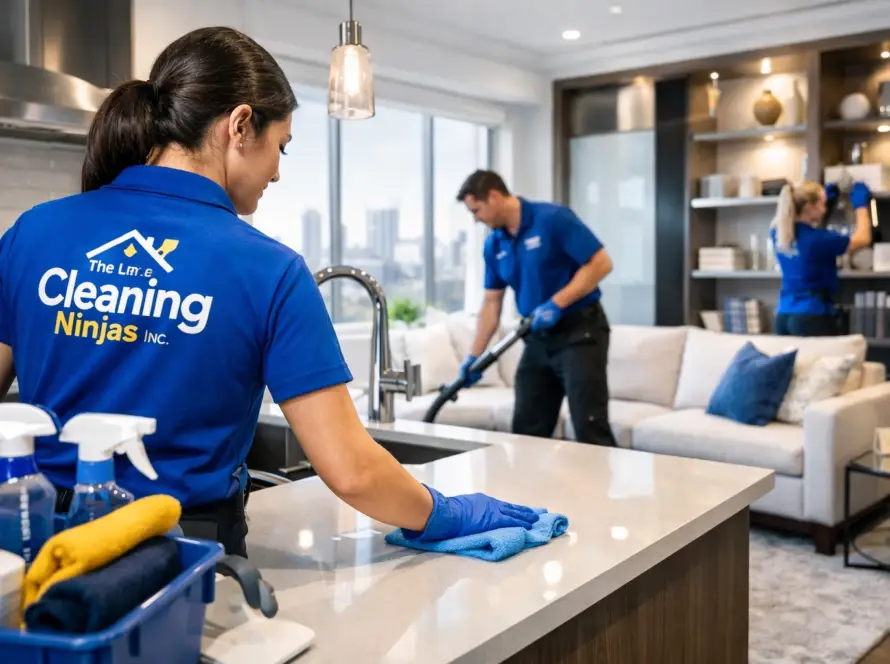
This is where The Cleaning Ninjas Inc come in. We don’t just provide a service; we operate like Environmental Engineers for your home—handling the matter, so you can conserve and compound the mental energy required for high-level output. By managing your weekly house cleaning, we give you back the bandwidth to execute where it actually counts.
The Cleaning Ninjas Standard
At The Cleaning Ninjas, we treat kitchens as the most influential space in your home. We know it’s the heart of your nutrition, your family interactions, and your morning routine. Our standard for weekly house cleaning involves more than just a quick wipe-down. We focus on:
- Sanitizing high-touch points to ensure peak health.
- Clearing visual clutter to restore your cognitive focus.
- Organizing surfaces to reduce friction during meal prep.
We create kitchens that support discipline and reduce the mental friction of daily life. So when you walk in at 6:00 AM to start your day, you feel ready and empowered, not overwhelmed by yesterday’s mess. Our professional teams are trained to see the kitchen through the eyes of a high performer.
Final Thought: Your Kitchen Is Programming You
Every single day, your kitchen is training you. It is training you to be reactive or intentional. It is training you to be scattered or focused. It is training you to be average or disciplined. The environment is the invisible hand that guides your behavior.
High performers don’t just obsess over clean kitchens because they like the look; they obsess because they understand what a clean kitchen does to them. They recognize that a clean space is the ultimate hack for a clear mind. By committing to a weekly house cleaning schedule, you are making a commitment to your own excellence.
Common Questions About High-Performance Cleaning
How often should a high-performance home be cleaned?
Most high performers find that weekly house cleaning is the "sweet spot" to ensure that clutter never reaches a level that causes cognitive overload. For those with less foot traffic, bi-weekly services can work, but the kitchen usually requires more frequent attention.
Does environment really affect stress levels?
Absolutely. Research, including studies published by the NIH, shows that women who perceive their homes as cluttered have higher levels of cortisol (the stress hormone) throughout the day. High cortisol is the enemy of focus and long-term health.
What is the "Deep Cleaning" difference?
While weekly house cleaning maintains the baseline, a professional deep cleaning removes the hidden grime and allergens that can affect air quality and respiratory health, further optimizing your physical performance.
Call to Action
If you’re ready to turn your kitchen into a high-performance space and reclaim your mental energy:
👉 Book your cleaning with The Cleaning Ninjas
Let us handle the environment so you can upgrade your habits, your discipline, and your results. Whether you need a recurring reset via weekly house cleaning, a strategic bi-weekly house cleaning cadence, or a full-performance deep cleaning to remove built-up friction, we are here to help. Explore options on our Services page or browse more performance-focused cleaning insights in our blog archive. Because success doesn’t start in your schedule: it starts in your environment. Don't let a chaotic kitchen tax your focus. Invest in weekly house cleaning today and experience the cognitive edge of ordered matter for yourself.