When you think about "cleaning the kitchen," your mind probably jumps to wiping down the counters, mopping the floor, or finally tackling that mystery Tupperware at the back of the fridge. But there is a hidden spot: a literal "out of sight, out of mind" area: that is likely costing you money every single second of the day.
At The Cleaning Ninjas Inc, we’re all about the details that make a home run smoother. One of the most overlooked maintenance tasks in the modern household is dusting the refrigerator coils. It sounds like a "dad chore" from the 1950s, but it is actually one of the most effective ways to lower your energy bill and be a better friend to the environment.
Why Your Fridge is Working Harder Than It Needs To
Your refrigerator is the only appliance in your home that stays on 24/7. It never takes a nap. To keep your milk cold and your ice cream frozen, it uses a cooling cycle that relies on condenser coils to release heat.
Think of these coils like the radiator in your car or the "lungs" of your appliance. Their job is to let heat escape so the inside of the fridge stays chilly. However, because these coils are usually located at the back or underneath the unit near the floor, they are magnets for dust, lint, and pet hair.
When a layer of dust builds up on those coils, it acts like a thick, fuzzy blanket. Instead of the heat escaping into the kitchen air, it gets trapped by the dust. This forces the compressor: the "heart" of your fridge: to work overtime. It runs longer and harder just to maintain the same temperature.

The "Ninja" Numbers: What Clean Coils Save You
We know that "energy efficiency" can sometimes feel like a buzzword, but the data behind coil cleaning is staggering. Research shows that dirty coils can increase your refrigerator's energy consumption by as much as 35% to 50%.
In a standard household, this translates to an extra $50 to $150 on your electric bill every year. If you have a high-end or commercial-grade unit, those savings can jump to over $200 annually.
But the savings aren't just in the monthly bill. A refrigerator compressor is designed to last about 15 years. However, if it’s constantly struggling against a wall of dust, it might give up the ghost by year 10. Replacing a fridge is a massive expense: often costing between $1,500 and $3,000 for a quality model. By spending 15 minutes a few times a year on coil dusting, you are essentially buying yourself five extra years of appliance life. That’s a massive return on investment!
The Step-by-Step Ninja Guide to Coil Dusting
You don’t need to be a professional technician to handle this task. Here is how you can do it yourself in about 15 to 20 minutes.
1. Safety First: Unplug the Unit
Before you go poking around the mechanical parts of an appliance, pull the plug. Since you’ll only be working for a few minutes, your food won’t warm up significantly. If your fridge is built-in and hard to move, you might need to turn off the power at the circuit breaker.
2. Locate the Coils
Depending on your model, the coils will be in one of two places:
- The Bottom: Most modern fridges have coils behind a "toe kick" or "grille" at the very bottom front. You can usually snap this plate off with your hands or a screwdriver.
- The Back: Older models or specific brands have a large black grid on the back of the unit. You’ll need to slide the fridge away from the wall to access these.
3. Use the Right Tools
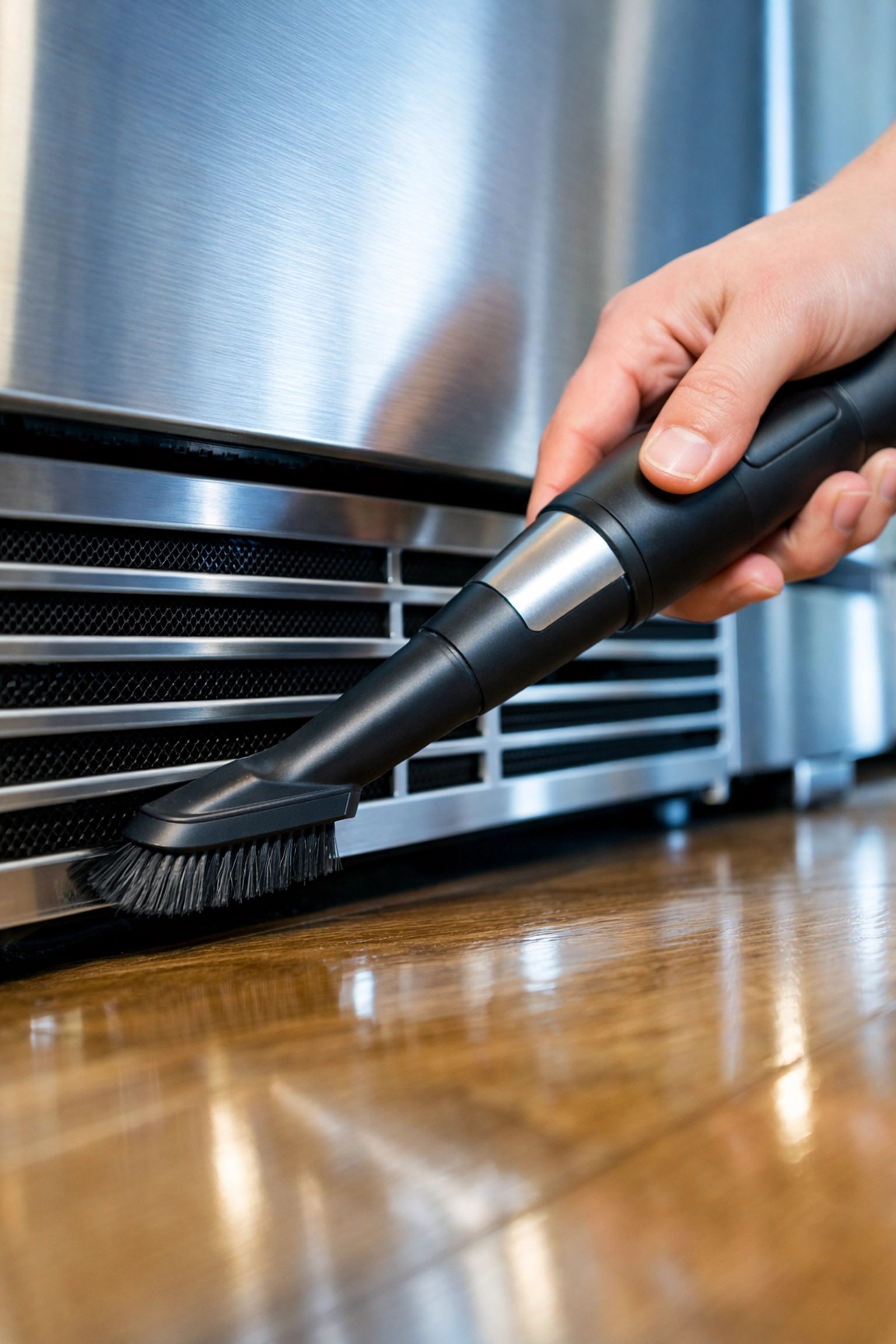
You don't need fancy equipment. A standard vacuum with a narrow crevice attachment or a brush attachment works wonders. For the best results, you can buy a "coil brush": a long, thin, flexible brush designed to get into the tight nooks and crannies: for less than $10 at most hardware stores.
4. The Cleaning Process
Gently vacuum the visible dust. If you have a brush, run it through the coils to loosen the stubborn "caked-on" grime, then vacuum up the debris. If your fridge is a "bottom-coil" model, make sure to get as far back as the vacuum hose will allow.
5. Don’t Forget the Fan
While you’re back there, look for the condenser fan. If it’s covered in hair or dust, it won't spin efficiently. Give it a quick wipe or vacuum.
6. Power Back Up
Slide the fridge back into place (be careful not to kink the water line if you have an ice maker!) and plug it back in. You might notice almost immediately that the fridge sounds quieter. That’s the sound of a compressor that no longer has to scream for help.
The Eco-Friendly Angle: Cleaning for the Planet
At The Cleaning Ninjas Inc, we believe that a clean home is a sustainable home. Reducing your energy consumption isn't just about the dollars and cents; it’s about reducing the load on the power grid.
Because refrigerators are such a universal appliance, if every household in the country cleaned their coils just twice a year, the collective reduction in energy demand would be massive. It’s one of the simplest "green" habits you can adopt. No expensive solar panels or new windows required: just a vacuum and a little bit of elbow grease.
Do You Have Pets? Read This!
If you have a Golden Retriever, a fluffy cat, or any pet that sheds, you need to put "Coil Dusting" on your calendar at least once every three months.
Pet hair is much more "insulating" than standard household dust. It tends to weave itself into the coils, creating a felt-like mat that is incredibly effective at trapping heat. We often find that in homes with multiple pets, the coils are completely blocked within just a few months. If you notice your fridge running almost constantly, or if the sides of the fridge feel hot to the touch, your pets’ fur might be the culprit.

Signs Your Fridge Needs a Ninja Visit
Sometimes we get so used to the background noise of our homes that we don't notice when an appliance is struggling. Here are the red flags that your coils are overdue for a cleaning:
- The Constant Hum: Your fridge should click on and off. If it seems to be running 24/7 without a break, it's struggling to reach its target temperature.
- Lukewarm Food: If your milk isn't as cold as it used to be, or if your ice cream is a bit soft, the cooling system is likely inefficient due to dust.
- Heat Radiation: If you walk past your fridge and feel a wave of heat coming from the bottom or the back, those coils are desperately trying to dump heat and failing.
- Higher-than-usual Bills: If your electric bill has spiked and you haven't changed your AC habits, look at the fridge.
Making Maintenance a Habit
We know that life gets busy. It’s easy to forget about the coils when you’re worried about laundry, work, and family. A great "Ninja Tip" is to tie this task to something else you do seasonally. When you change your smoke detector batteries or your HVAC filters, grab the vacuum and head for the fridge.
Maintaining your home shouldn't be a source of stress. It’s about protecting your investment and ensuring your sanctuary runs efficiently. If you find that deep-cleaning tasks like these are sliding off your to-do list, that’s where we come in. While we focus on making your living spaces sparkle, we love sharing these tips so you can keep your home’s systems in peak condition.
Conclusion: Small Task, Big Impact
Dusting your refrigerator coils is the ultimate low-effort, high-reward chore. For the price of 15 minutes and a little bit of dust on your knees, you get a lower power bill, a longer-lasting appliance, and the peace of mind that you’re doing your part for the environment.
If you’re interested in more ways to keep your home running like a well-oiled machine, check out our other Cleaning Tips. Or, if you’d rather leave the deep cleaning to the pros, learn more about us and see how our services can give you back your weekends.
Happy cleaning, and may your fridge stay cold and your energy bills stay low! 🥷✨